





Nausicaä of the Valley of the Wind(1984)
Kaze no Tani no Nausicaä
MyAnimeList
8.36
254K VotesAnilist
81
UnknownTmdb
7.95
3.7K VotesViewings
No viewings yet. Add one to start tracking.
Finished
A thousand years after a global war, a seaside kingdom known as the Valley Of The Wind remains one of only a few areas still populated. Led by the courageous Princess Nausicaä, the people of the Valley are engaged in a constant struggle with powerful insects called ohmu, who guard a poisonous jungle that is spreading across the Earth. Nausicaä and her brave companions, together with the people of the Valley, strive to restore the bond between humanity and the Earth.
(Source: Disney)
Where to watch

Watch Order
8.36
Anime
Nausicaä of the Valley of the Wind
Infos
Episodes
1
1
Episode Duration
117 minutes
117 minutes
People Interested
23
23
People Watching
1
1
People Finished
79
79
Release Status
Finished
Finished
Start
3/11/1984
3/11/1984
End
3/11/1984
3/11/1984
Related Titles
Recommended Titles
Reviews
aleks-predator
4 months ago
7
When Science Fiction Speaks Seriously
"Nausicaä of the Valley of the Wind" is a film I first watched as a child but only truly understood many years later. At the time it was one of my first encounters with the work of Hayao Miyazaki and with Japanese animation in general. I didn't yet know that I was looking at the foundation of the future Studio Ghibli and one of the most extraordinary animated films of my life.
The story is built around a world that has survived catastrophe. The earth is poisoned, toxic vapors drift everywhere, venomous forests spread across the land, and giant insects roam freely. The remnants of humanity shelter in whatever corners have survived — one of them being the Valley of the Wind. This is where Nausicaä lives: a princess who knows how to coexist with nature and tries to understand what is happening rather than simply destroy everything around her. She is a young woman who seeks, explores, and tries to protect a fragile world on the edge of annihilation. In essence she is a defender of everyone from everyone else — someone who sees further and deeper than others are willing to look.
She is not a superhero or a warrior, though she is capable of defending herself. What defines her is kindness and curiosity. She does not seek war, but she is prepared to protect the world she loves. And it is precisely because of characters like her that this story moves you — because they are easy to believe in.
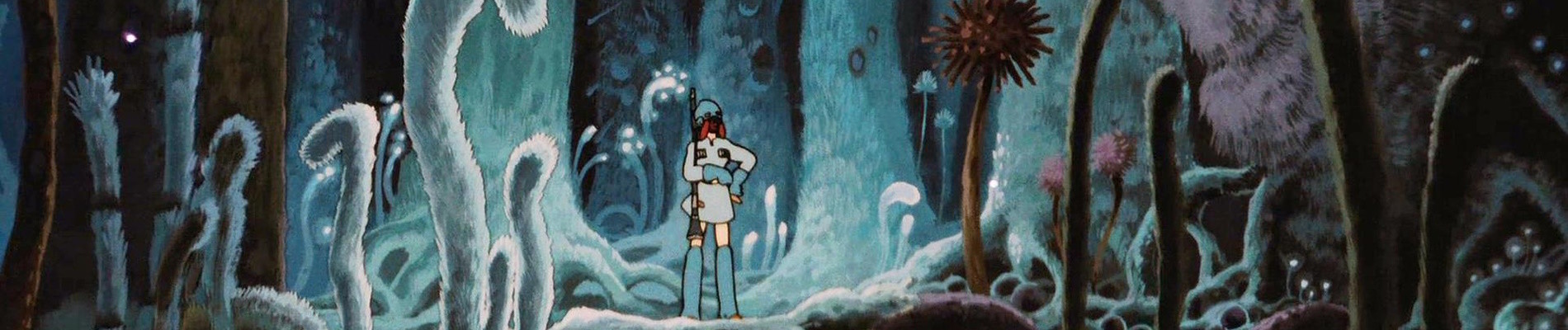
As for the visuals — there is hardly anything to add. This was a phenomenon. Yes, the film was drawn in the 1980s, but it still catches the eye today. Every frame feels as if it were crafted by hand with love. The insects are alive, the forests are frightening and beautiful at once, the machinery is strange yet functional. Miyazaki knows how to build worlds, and here that gift is particularly evident.
Separate respect is due to the music of Joe Hisaishi. His melodies don't play "in the background" — they create mood. Anxious in one place, luminous in another, frightening in yet another — always exactly right. Without this music, the film simply would not work the way it does.
What surprises you is that for all its fairy-tale quality, the film raises questions that are anything but childlike: what are we doing to the planet, why is it easier to wage war than to seek understanding, and is it even possible to make contact with something you fear. And the film does this without beating you over the head with it — it simply tells a story, and the viewer draws their own conclusions.
"Nausicaä" is a story worth returning to from time to time. And each time, finding something new in it — especially if a few years have passed. As a child, it's simply beautiful. Revisiting it as an adult, you begin to understand what is truly more frightening: the forest, or the people with guns.
If you still haven't seen it, give it a try. It really is more than just an animated film — it's an entire universe with its own vivid and authentic story. And Miyazaki is a visual innovator who built his own unmistakable style and created imagery that went on to become his calling card: something recognizable, something spectacular, something entirely his own.
7 out of 10